Search This Blog

Showing posts with label Chire. Show all posts

Goa - Chapel of St. Catherine in Old Goa

Thursday, March 26, 2015

St Catherine Chapel is located very close to Church of St Francis of Assisi.
Entrance to St Catherine Chapel

Chapel built of Chire. Stone used in the construction of houses across Goa. The Front of the church is painted white in portions, rest is chire so it has the color of stone, Red. 

No services are held here. 

The Chapel is dimly light on the inside, hence the photos are dark.
Interiors made of Chire, the place where once stood the Altar
This Chapel was built in 1510 by Afonso de Albuquerque the then Portuguese Governor. The day he conquered this part of Goa from Adil Shah of Bijapur, it was the feast of St Catherine, so the Chapel was built to commemorate the same. 25th November 1510 is the feast of St. Catherine. 
Another entrance to the Chapel
On the opposite side of the road, I saw a small portion of the wall. Not sure what it was though we landed to explore it. But history states that it was the fort wall.  Afonso de Albuquerque entered the fort via this wall, after conquering this fort from Adil Shah he demolished the mosque and built the Chapel in its place. 

Goa - Fort Aguada

Wednesday, February 11, 2015

After visiting Reis Magos Fort we headed off to Fort Aguada.


History of Fort Aguada
A little bit of history about this place via the photo.

It took us around 30 minutes to reach here. 
Moat to enter the Fort
Have to say that this Fort is again very well  maintained. Also it gathers a huge crowd. Both locals and foreigners. 
The fort calls and external walls

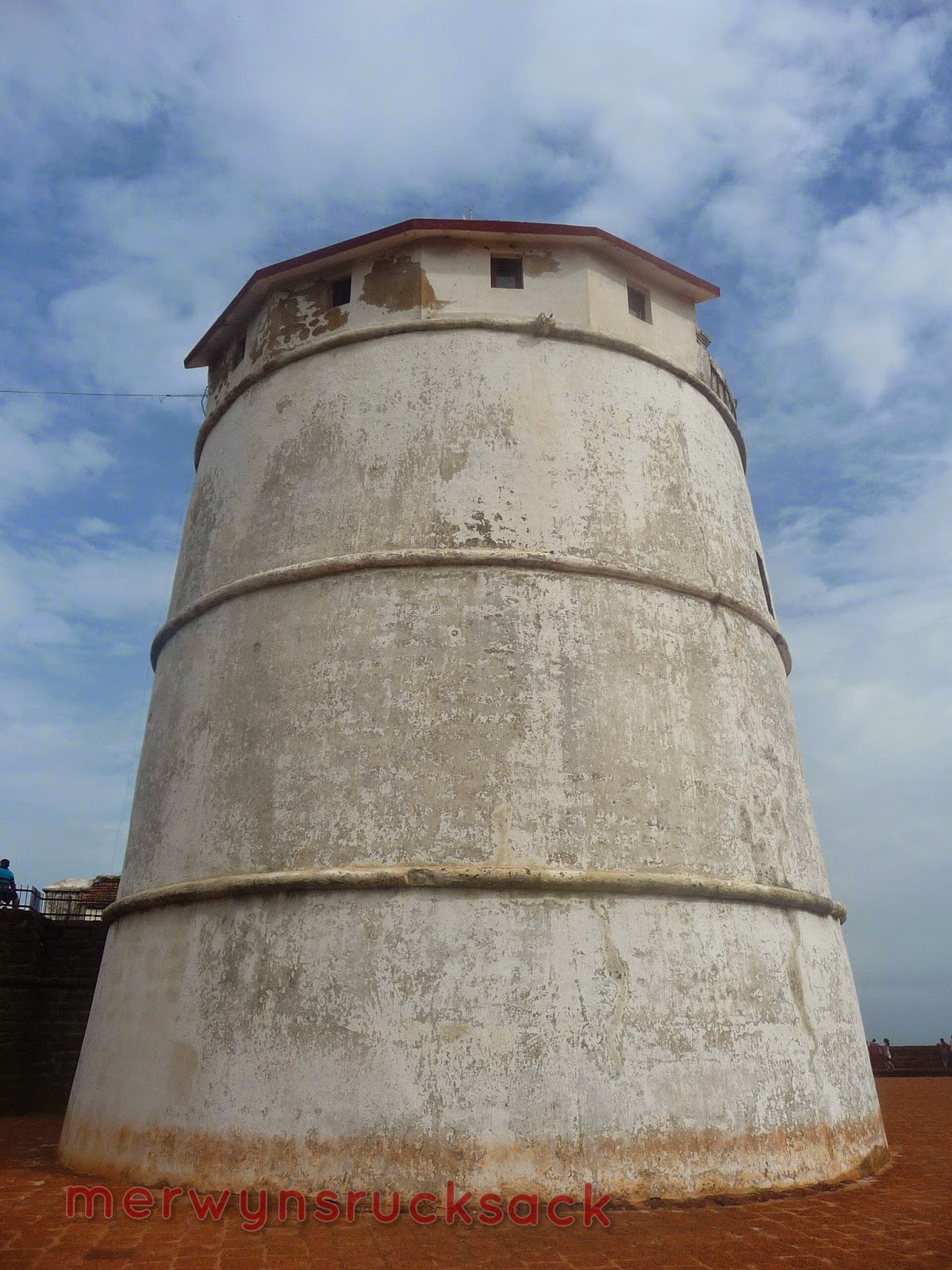
Old Light House in Fort premises
There is no fee to view this fort unlike Reis Magos, the timings are from 8:30 AM to 5:30 PM. This fort is maintained by the Archaeological Survey of India. 
Old Light House and underground dungeons
The Fort is not tall in height also there is a moat to enter the fort. The fort is 3/4 on land and 1/4 exposed to the sea. The fort has an internal wall and external wall. in the rains water gets filled between the walls. It had historic significance, refer to photo for the history bit. 
View of the fort from the fort walls
Again this fort is made of chire. Prime stone used in the construction of houses and forts in Goa. Certain entrances or rooms in the fort premises are under lock and key. Maybe due to hideous activities which happened there. The fort has a light house and under ground dungeons which are closed to the public. There is no shade within the fort premises. There is a small house which is closed and no trees in it. 
One of the fort bastions
One thing I observed here is that there is no graffiti on it. Which is a good sign. The walls of the fort are very well maintained. Also the fort premises is very clean. So please don't dirty it by throwing wrappers and water bottles around. 
Fortification
The fort is square in shape and can be done by walking on the broad walls of the fort. The fort offers a panaromic view of the sea on one end and the land on the other. One can also see the New Light House built very close to it. 
View from the fort
The new light house is functional and open to public but for  a small fee. The light house offers an amazing 360 degree view of the surrounding. Photography is strictly prohibited here.
Church in a distance
There is no food and refreshments available in the fort and new light house premises. Outside there are a lot of stalls that cater to food and water but they charge a premium fee.
Fort Aguada

Goa - Cabo de Rama Fort

Monday, December 1, 2014


Cabo de Rama Fort also known as Cape Rama fort is located in located in Cancona district in Goa. It is located at the southern tip of Goa. Margao is located 25 KM away from here. 

After having breakfast at Madgaon Cafe in Margao we headed off on the bike to visit the fort. 

The roads to Cabo de Rama are lovely and it is fun driving on them. The locals are very helpful with directions. We found churches and markets on the roadside too. 

We inquired with one of the locals about the fort. He replied, "That is the fort" Pointing ahead. A yellowish color structure stood there. "That?" I asked to which he replied "Yes."


We raced to the fort and finally were there. We parked our bike near the bus. A private bus which plies from Margao City to this fort. But no sign of the driver on it.


Cabo De Rama got its name from Lord Rama. Legend goes the Lord Rama had taken refuge here with his wife Sita when he was exiled from Ayodhya for 14 years. 

Now this was much before the fort was built by the Raja (King) of Soonda. Portuguese defeated the Raja of Soonda to take possession of the Fort. The Portuguese fought continuous battles with Hindu and Muslim Kings inorder to retain possession of the fort. The Portuguese kept making amends to the fort. But they later deserted the fort in search of something better. 

The fort currently has got fantastic fortification, a church of Santo Antonio (St. Anthony) in its premises and a couple of broken down structures in its premises and cannons The fort has drop dead cliffs all around it. It offers an interesting view of the sea and another hill next to it. 

The fort is surrounded by a moat on one side and the sea on the other. The moat is filled with wild vegetation. The the moat was huge we were not sure, as to how deep it was. Moat can be a great way to protect the fort from enemy attacks. This is the second instance of a moat, the first one I had seen in Daulatabad in Aurangabad


The walls of the fort are built of Chire. Chire's are used all over Goa to built houses and boundary walls. This is from where they originated. Though the walls of the fort are in good condition but they are not  tall enough. Maybe that's why they built a moat around it.


The entry to the fort is via a big yellow color building tiles on the roof. Two cannons are placed on either side of the entrance to welcome you. I can recollect a smiliar entrance at Vijaydurg Fort where in cannon balls were placed on either side of the entry point. 


The Yellow House houses a very old statue of St. Mark who was martyred on a tree.


We entered the fort premises now. We saw the St. Anthony Church in a distance. A couple of cannons scattered all over the place.


As it had just rained here, the smell of the soil was just amazing and  it was green all over.

The best way to see the fort is my walking on the walls of it, and that is just what we did.


As the fort is located at the end of the land  it offers a beautiful view of the sea and land around.

In a distance we saw a small rock with a tree on it. As the sea was rough, the water was lashing on it. We were waiting here to get a perfect shot.


We located this water body on the fort premises. Currently filled with muddy water. But it has steps leading to it on one side. Maybe once upon a time, it might have been surrounded by steps on all four sides leading to it. This is what remains of it.


There are a couple of structures on the fort. But today they are just walls with no roofs, maybe these were houses once upon a time.


Fort has a couple of bastions which offer a very good view of the Fort, but as it is monsoon there is wild vegetation all over. As we wore shorts here we were attached by mosquitoes. On my legs there were at least 8 mosquitoes trying to suck blood at one point and me trying to kill them. They managed to suck blood out of me and I managed to kill them all in the end. Damages I suffered , loss of blood and mosquito bite marks all over my legs till the knee.So if you visiting this fort do wear long pants.


Soon the weather changed, The sun was making its presence felt and we started to sweat and thirst for water. But that didn't dampen our spirits and we still went on exploring the fort.


In a distance we saw the color of the water. Two shades of water. It was due to the shallowness on the water.


We managed to locate another way to enter the fort. The walls of this entry point had small crabs all over it. There were steps here which took us to down to the sea. There is no beach here but just small pebbles and rocks to which water was lashing against due to the tides. The smell of it was awful. The water was dirty.

We climbed up the stairs once again and started walking on the walls. We noticed a few cannons here. These cannons had emblems on them. Thought he emblem was not clear there was a number 1206 below it. Trying to understand what that meant. Was it that there were 1206 cannons atop this fort or was it built in that year. This remains a mystery. Saw cannons with emblems in Daman


Had noticed cannons with emblems in Moti Daman fort too.


We finally reached the St. Anthony Church. There is no date mentioned as to when the Church was built. Maybe it s mentioned on the inside. The church is painted white in color with dark blue borders. The Church shone in the hot sun. Making it one of my best pics on the fort.

Services are held in the church. The church was closed as it was a weekday and there was no way we could enter its premises. The area around the church is clean and the vegetation nicely trimmed. The church has 14 Stations of the Cross around it. All churches have the 14 Stations in it, this is the first time I have seen something like it on the outside.

Guess how many people were here. Just the two if us. We walked out of the fort and entered a shop on the outskirts of the fort. We had cold drinks here. We inquired as to how many people come here, to which we were informed that in the summers loads of people pay it a visit, but thi sis off season and so its just us.

We refreshed ourselves and kick started to Margao city.


We skid and fell in the fields as our bike lost control on a sharp right turn. We were driving at a speed of 70 km per hour.State of our bike and my pants here. As the fields were filled with water we didn't get hurt but managed to get bruises on our legs and hands. First fall on our trip.

We then moved to our second spot the Holy Cross Chapel at Baradi.

Popular Posts

Related Posts Plugin for WordPress, Blogger...