Search This Blog

Showing posts with label Buddha. Show all posts

Ajanta Caves in Ajanta near Aurangabad

Monday, May 19, 2014

When it comes to Caves, the first thing that comes to our minds is Ajanta and Ellora Caves. Though I had never been to these before, I decided to take this trip to explore these caves.


Ajanta Caves
As I was fascinated with Ellora Caves, I decided to visit Ajanta Caves located on the outskirts of the city.

Ajanta Caves are situated in Ajanta at a distance of 105 km from Aurangabad. So I am guessing that it would take around three hours to reach it. So three hours to go, three to comeback and two to see it. That means an entire day is gone is viewing the caves. That did not stop us from visiting the caves.
Painting in the Cave premises


We asked a day before at the City Bus Stand regarding the bus to board and the timing, so that we can plan the day accordingly. The person sitting at the “May I Help You” board replied that we can board any bus going to Jalgaon and alight at Ajanta to view the caves and those buses ply every 30 minutes.

So the next morning at 630 hours we were at the Bus Stand, we were lucky to get a place in the bus. The bus started off at 645 hours, we got ourselves tickets at the cost of Rs.91 per head, Namrata told the bus conductor to intimate us when we reach. We had also told the passengers nearby to intimate us in case the bus conductor forgot.
Beautifully carved Pillars


At 845 hours we were alighted on the road that leads to Ajanta Caves, and our bus moved on to Jalgaon. From there we took a ticket at a cost of Rs.10 per head to enter the market area.

The market area was full of small shops that cater to food requirements and souvenir shops selling  stones and ornaments.

Finally we landed at the bus stop to take us to the entrance of the fort. Non AC buses charge Rs.7 and AC buses charge Rs.12 for the 20 minute journey to the hills. Note that no private vehicles are allowed here. Private vehicles need to be parked near the market area. These buses are run by the State Govt. of Maharashtra.

At the entrance we were greeted by cheap jacks selling precious stones as they claimed and CD’s on Ajanta and Ellora Caves. Some of them even had CD’s on the Khajuraho Temple. Wonder how he can make a sale of those CD’s here in Ajanta.
Beautifully Carved Caves
We got ourselves a ticket at a cost of Rs.10 per head plus another ticket at a cost of Rs.5 for both to see the paintings within the cave. The caves are open from 900 hours to 1730 hours. They are closed on Mondays but open on National Holidays.

We started our climb up the stairs to reach the cave. The stairs pressurize your knees till to reach the top, meaning the climb is difficult.

There are chair cars available at a cost of Rs.600 to see the caves. We decided to take the services of our legs to see them.
Stupa
The caves can all be seen from the start point. Meaning the caves are built in a circular formation. Inner circle.  There are 29 caves in all. Out of which the last three are inaccessible to public. Some of these caves were built in the 2nd century BC. These were built by the Buddhist monks for prayers and as monasteries. 

They were later abandoned. Later in the 18th century they were rediscovered by the British who had come hunting there for a Lion who took shelter in these caves. The British intimated the Nizam about the same, as this area was under his rule and so started the exploration of the caves. As told to us by the guide.

All the caves are numbered from the east to the west.
Paintings on the Cave Ceiling
All the caves are beautifully carved out of the rock. Some had beautifully carved pillars in them along with carvings of Buddha on the walls and a huge Buddha sculpture carved in the middle. This was the phenomenon in all caves.

Some caves had paintings on the walls and the ceilings too. Imagine in that time they painted the walls and the ceilings and the paint has survived for centuries. Look at the paint which we paint our houses from the inside and outside, it needs to be changed every 5 years as it is spoilt by the heat and water leakages. Maybe the paint manufactures should go back in time and take tips from the monks who had painted these caves.
Caves
I like Cave.26 the most has it has a huge reclining statue of Buddha carved on the walls along with other poses of Buddha. It also has a stupa and many beautifully carved pillars in its premises.

Some of the caves were so dark and so poorly lit that it was difficult to take photos in it without using the flash, as flash was banned in the caves. Flash spoils the paintings on the wall hence no usage.

The good news is that drinking water is available on the cave premises and so are toilets available. These are usually missing all over the historic sites in Maharashtra.
Beautifully carved Stupa
Our guide told us that the Japanese Govt is investing in the up keeping of these caves. To this I was ”What, Why”, is it that our Govt has no money in the bank that they need to take the help of the Japanese to upkeep the caves. This is ridiculous as Maharashtra is the richest amongst all the other states and we still begging for help. That is ridiculous.
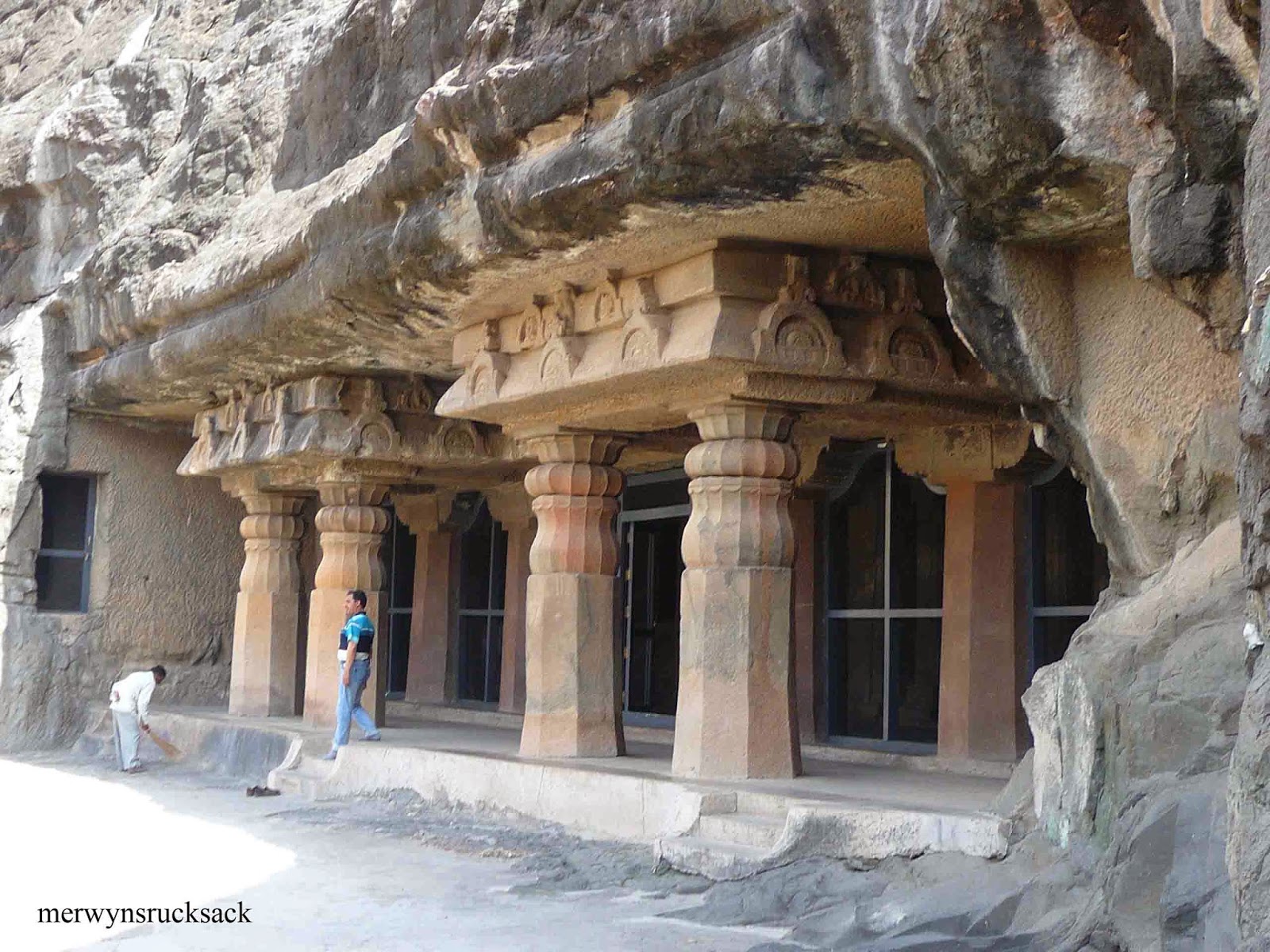
Carvings
I guess we are more interested in making money that the moment we found someone ready to invest we could not resist the offer. Any which ways it’s good that the caves are being looked after. Though we are late but still we can protect what remains.

The wooden bridge on the river Waghora, offers an amazing view of the Caves. If you have a camera with a 14mm wide angle then you can get the caves in a single shoot instead of sewing images together on a normal camera.
Carvings
A big thank you to the Japanese for investing in the up keeping of the caves. Though I didn’t like the nets that are placed at the openings in the caves. I guess the nets are placed to keep bats away from the caves that stay there and have droppings all over the caves. The caves are home to them, so I guess they should be kept the way they are.

I personally don’t like the new net covering for the caves. The same is spotted even at Ellora Caves located in Aurangabad.

It took us around two hours to see the caves.
Ajanta Caves
Again we boarded the Non AC bus to reach us to Ajanta Car Park from there we landed on the highway to board a ST bus to take us to Aurangabad.

Finally after travelling in the bus for three hours at 1600 hours we were at the City Bus Stand. Tired. Phew.

Ellora Caves

Wednesday, April 23, 2014

As we entered Ellora Caves we took a ticket at Rs.10 per head and Rs.10 for rickshaw parking and then headed off to see the caves.


Our driver called out to us and said to us, Checkout cave no. 1 first and then come here to cave no. 16 to which we readily agreed.

Ellora Caves is also known as Kllooru is located 29 km away from Aurangabad. These caves were built by the Kannadiga Rashtrakuta Dynasty.

There are not only Buddhist Caves here but also Hindu and Jain Caves all of which were built in between the 5th century and 10th century.

When Namrata first told me about Jain Caves, I couldn’t believe it as I had never heard of Jain Caves before and so thought that she was pulling a prank on me.


Caves 1 to 12 are Buddhist Caves.
Caves 13 to 29 are Hindu Caves
Caves 30 to 34 are Jain Caves


The Buddhist Caves were built first followed by the Hindu Caves and later the Jain Caves.


Most of the caves are identical in nature. They had small doors cut out in the rock that I guess served as rooms to stay. Some had carvings at the entrance of the caves. Buddha in various meditation poses.

There were many caves which had huge beautifully carved pillars in them and in the centre there was a rock cut door in which there was a huge carving of Buddha accompanied by other carvings. The walls of these caves were carved with both small and huge life size images of Buddha.

Cave no. 10 features Buddha sitting near a Stupa. There are beautifully carved pillars around the Stupa. The ceiling too is beautifully carved with carvings near it. This is the first stupa I have come across that has a Carving of Buddha near it.


Cave no.11 is like a two storey cave carved in the rocks. The walls of which were carved depicting Buddha in various poses. There were rooms carved on each of the storeys.


The Hindu Caves had carvings on them depicting various Hindu mythological figures.
Cave no. 15 The Dashavatara, is a beautifully carved temple in front of a one storey excavated temple carved in the rock. Again it features carvings of Hindu mythological.


Cave no. 16 is the best find of them all. I took me to another world altogether. It’s called the Kaliasanatha. This entire temple is carved out of one single rock. This temple is beautifully carved.


You have to pay a visit to this place to admire and capture the beauty of this place on camera.


I just didn’t want to leave the temple premises. Truly a beautiful masterpiece created out of rock.


The other caves were more or less similar to the caves I had seen earlier in Ellora.


Global Vipassana Pagoda

Tuesday, April 3, 2012


Ever since I had set eyes on this pagoda while on the Manori trip with Hithakshi, I had been entranced and had made up my mind to pay a visit to it.
 So I invited readers to join me on a visit to the pagoda. Sherwin and Grace agreed. We decided to meet at Bhayander railway station at 3 pm. From there we were supposed to take bus no 4 to the Pagoda.
 I reached Andheri station at 2 pm. The platform was crowded, as were the trains. I let two trains go by and finally the 2.26 pm Bhayander Fast train arrived. I had to get in this train, or else I would be late. Luckily I managed to board it.
The Global Vipassana Pagoda

Grace was already there. Sherwin and I boarded different coaches in the same train. We planned to meet at the ticket booking counter from where we were to proceed to the bus depot.
Grace, who I met on the platform, had already reached the ticket counter but there was no sign of Sherwin. So I called him up to locate his whereabouts, and it seemed as if in an instant, there he was right under my nose. I hadn’t been able to spot him a few seconds earlier.
For a change we were all on time and proceeded to board the bus that would take us to the Pagoda. We were quite disappointed on learning that the next bus would leave in an hour. We boarded the 3.40 pm bus and reached the Pagoda after an hour. The bus conductor told us that there were hourly return buses. The last bus from the Pagoda to the station was at 8.30 pm and the cost of the ticket was Rs. 13 one way.

Entrance to the Global Vipassana Pagoda

Rickshaws too ply to the Pagoda. I don’t know how much a rickshaw ride would cost.
The Pagoda is the last stop on this route, two stops prior to the Essel World bus stop.
 There is no charge to visit the Pagoda and even the tour guides are free of cost. The Pagoda, open from 9 am to 7 pm, has been built completely on the strength of donations. There are donation boxes kept all around.

The Bell

The Pagoda looks amazing from here. Some parts of the structure are still incomplete, and construction is on. We entered the premises via an entrance neatly carved and painted golden and red. There were carvings of two animals there. The carvings looked very impressive, but I could not identify the animals.
We later climbed the steps and saw two identical structures just ahead of the Pagoda. There was a sculpture of four huge men carrying a bell. The bell was poised on only one structure. We rang the bell. The sound was very loud, but strangely soothing.
We entered the Pagoda. The security check was very strict here unlike the kind done in our malls and railway stations. I was happy to see that.

Statue in the premises

The Pagoda was huge and painted golden. When the sun’s rays shone on it, it looked even better. There were steps leading right up to the topmost point on the Pagoda. Right on top there are wind chimes placed which ring with even the slightest movement of the wind. The sound of the wind chimes is very pleasing to the ears.
The design on the outside walls was repetitive. Again it was a combination of gold and red colours. The walls have been covered with stone tablets featuring proverbs.

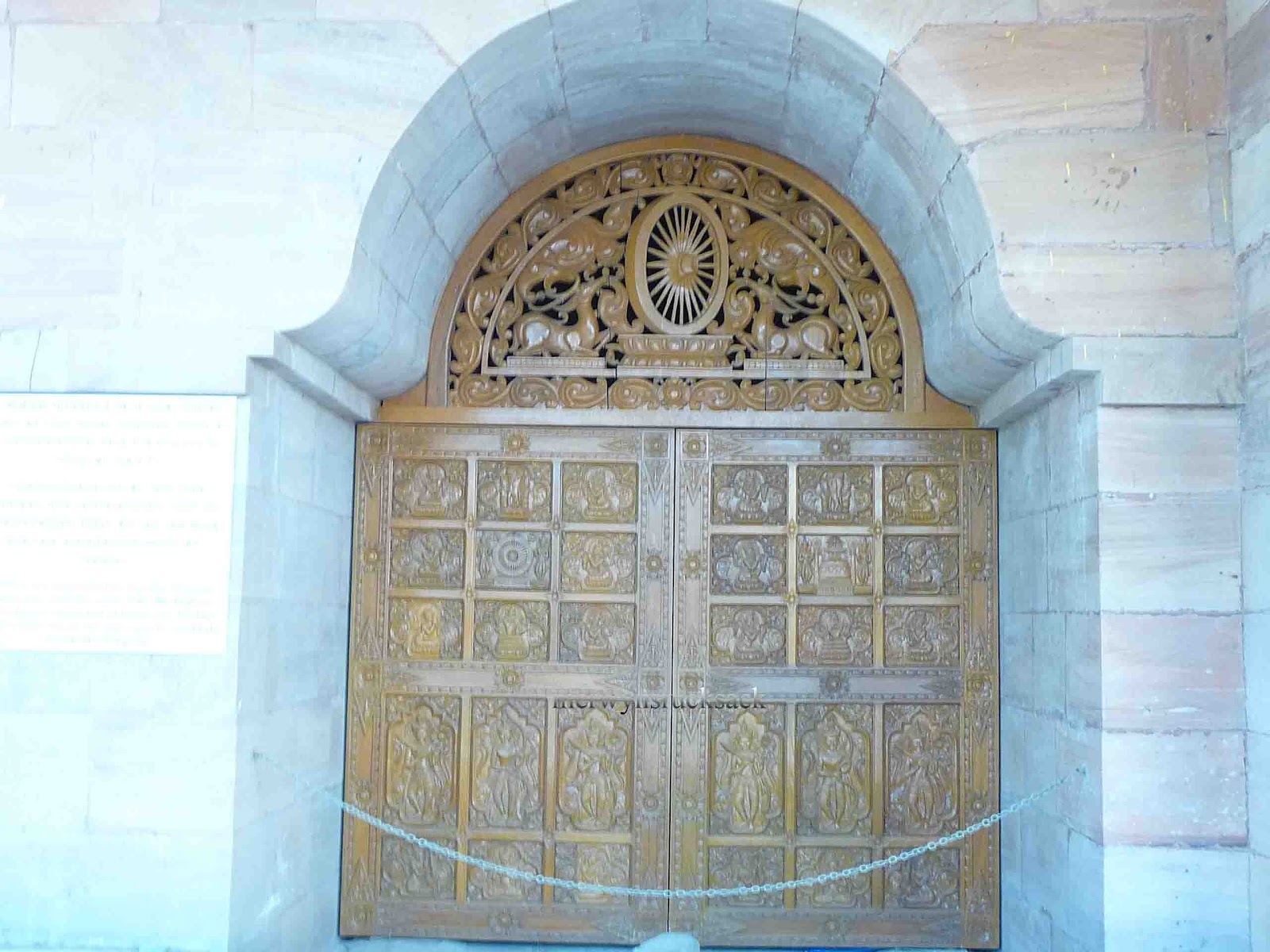
The Pagoda has many entrances, but only entrances 7 and 8 are open to the public. The same design was visible on the doors and the walls.

One of the Doors of the Pagoda

The seating area was huge and could accommodate around 8,000 to 10,000 people. The guide who showed us around told us that that no cement had been used to seal the stones and that they were interlocked with each other via the central locking stone of the dome. The bone relics of Buddha are enshrined in the central locking stone. The Dome does not have any supporting pillars to carry its weight.
 There was complete silence in the dome so we refrained from making any noise ourselves but silently continued with our photo sessions.
Later we saw the other smaller domes which are still under construction.

Inside the Pagoda

By the time we finished our photo sessions, it was around 6 pm. We decided to wait until 7 pm hours as the entire place was beautifully lit up.
 We then visited the Photo Gallery below the Pagoda; it features 123 photos, mostly related to Buddha’s lifetimes. There is an audio clip available on a payment of Rs. 20, along with a deposit of Rs. 100.
 Later we headed to the store which sells Pagoda merchandise. By the time we were done it was already dark and the lights were up near the Pagoda.

Group Pic, from left Grace, Me and Sherwin

The pagoda shone beautifully in the dark. We got some really amazing shots.
 As always hunger struck so we headed to the food court nearby to have some refreshments there. The refreshments were priced quite high but as we were hungry we didn’t mind, not that we had a choice. We concentrated more on eating and drinking and finally decided to bid farewell to the Pagoda.
 Just before leaving, we visited a huge statue of Buddha near the food court. There were lights all around the statue. It looked amazing, especially set against the backdrop of the Pagoda looming large behind it. It was truly a beautiful sight.

A statue of Buddha near the Pagoda

 We were luckily in time to board the 7.30 pm bus and managed to bag some seats in the bus. Within a few minutes we were at Essel World and a mad mob of people rushed in to board the bus. The crowd was worse than the one I had seen in the train that I boarded to reach Bhayander. As we had seats we were lucky not to be pushed around. In an overloaded bus, the risk of a fight erupting is quite high. Finally after all the commotion, we reached Bhayander railway station in an hour.
I don’t understand why the BEST does not put in more buses for the convenience of passengers, especially the Essel World returnees.
Luckily we got a fast train at Bhayander railway station to take us to Andheri.

The Pagoda at night
The Pagoda looks beautiful from the outside and that too from a distance. When you get close to it, the flaws in it become more visible. I am not saying that the design is bad, but had the monks built it, it would have been a marvelous piece of art.

We then headed home. I had to plan and pack for the Matheran overnight trip. I had had good fun with Sherwin and Grace.
 Hope you had fun reading. Join me soon on my next travel post.

Popular Posts

Related Posts Plugin for WordPress, Blogger...