I had never been to the hot springs before. I checked with my net reference, Google, and learned that a hot spring is a component of the hydrosphere; it is a natural occurrence where water flows to the surface of the earth from below the surface.
So I decided to pay it a visit. Now I had been planning this trip for quite some time with Hithakshi. But somehow we could not make it. Finally one day out of the blue, Milind, a college friend, called me and we decided to head to Vajreshwari.
I immediately filled my rucksack with a 2.25-litre bottle of water, a must to cope with the heat, along with my camera and scarf and headed off to Andheri station.
Now there was a huge crowd for the tickets at the station but I was lucky enough to get tickets immediately and boarded a Virar local. I wasted no time and immediately messaged Milind to let him know when the train would reach Borivali and the compartment that I was in.
 |
| Vajreshwari Temple |
In five minutes, the train was at Borivali and Milind got in the train. He had brought no bag along. I was happy that at least one of us was carrying a water bottle. I always advocate the carrying of a water bottle to meet any emergency. Food we were supposed to eat on the way wherever we saw an eatery.
At 12:20 noon, we were at Vasai Road railway station. We then headed to the ST bus station to board a bus to Vajreshwari. We refreshed ourselves with some sugarcane juice at the bus stand and then inquired at the inquiry desk about the timings of the bus. The buses, we were told, plied at a frequency of one every half hour; the next one was at 1 pm. We had to board a bus going to Vajreshwari or Akaloli.
We had ½ hour in hand and so instead of wasting time at the bus station, we decided the time would be better spent eating. We had Tomato Onion Uttappa at Hotel Haridwar. An Uttappa is a dosa-like dish in which other ingredients like tomato and/or onion, chilli are mixed with the batter. The uttappa took very long to arrive, so much so that we were afraid it would cost us our bus.
Finally everything happened in the nick of time. Our food arrived, we ate and immediately left. As we reached the bus depot, we learned that our bus had arrived and was waiting for us.
 |
| Within Vajreshwari Temple premises |
We immediately boarded the bus and got ourselves seats on the last row in the bus. We both knew that the journey would be a rollercoaster ride all the way for the next one hour. Our tickets cost us Rs.57.
We had been on the road for nearly an hour when the passengers, some of them, began to disembark. So we hopped on to seats in the front. Finally at 2:20 pm, the bus reached. Vajreshwari Temple The roads were empty all the way but as soon as we neared the temple the traffic jams started. Fortunately, the bus wasn’t caught in the jam for too long.
The Vajreshwari temple is located on a hillock and a series of steps take us atop the temple. The roads near the temple are very narrow; there are shops on either side of the road. These shops sell food and articles of worship
 |
| View of the fort of Mahuli from Vajreshwari Temple |
We headed off to the steps. There were yellow coloured circles, two of them in the middle of the stairs. They started from the ground and went on all the way to the top. There were small wax lanterns (diyas) kept on the stairs. I also spotted a golden tortoise on the steps.
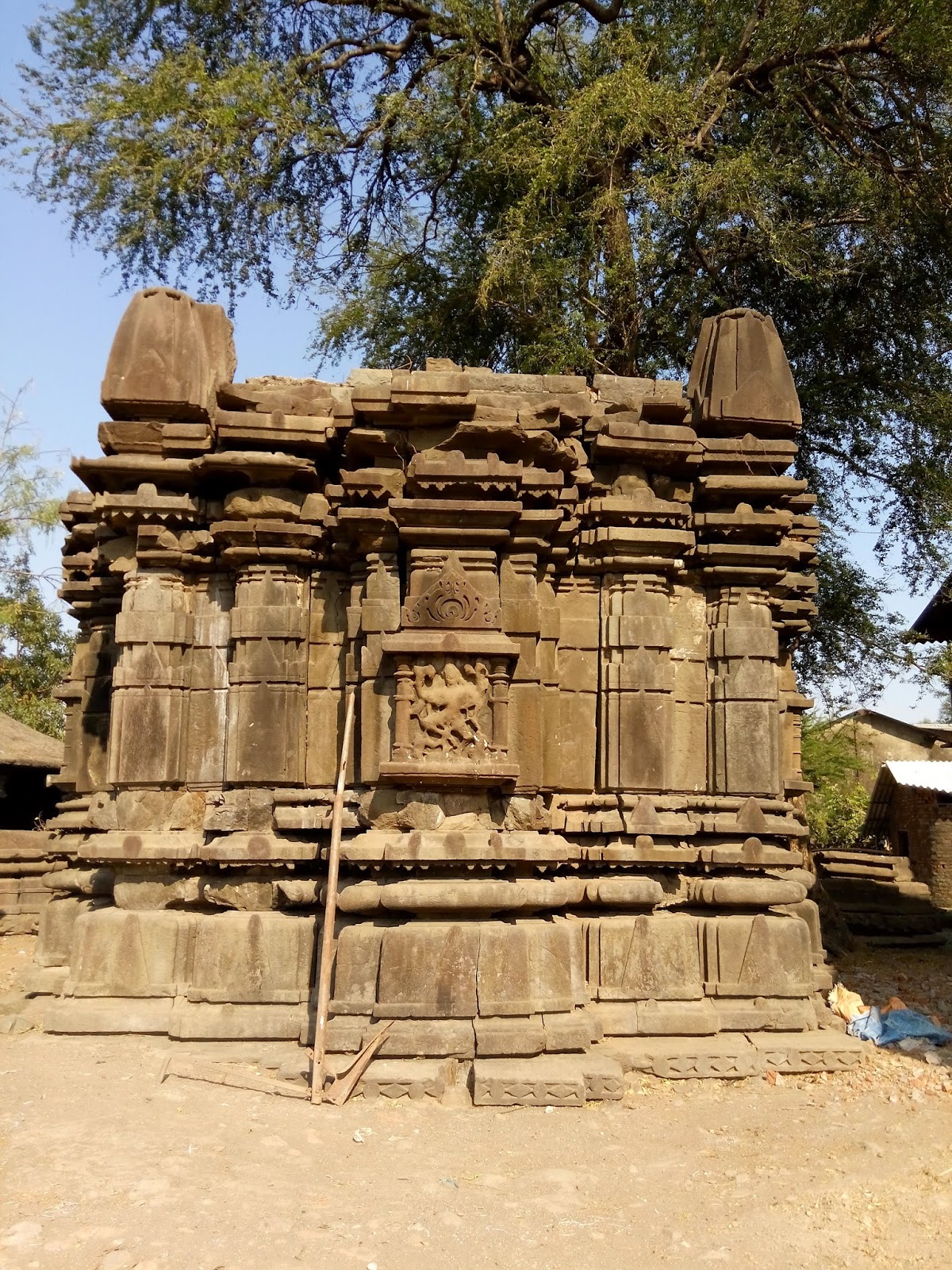
We finally reached the entrance of the temple. The walls of the temple looked as if they were the walls of a fort. Even the stone used to built the temple looked liked the stone used to build fort walls.
The temple was beautifully carved out of the rock; even the pillars of the temple were beautifully carved and coloured. There are many small temples in its premises.
There was a big crowd to see the temples. The temple premises are quite small and it would take less than 20 minutes to see the temple. Now I had a question in my head. Where are the hot springs?
Milind asked one of the caretakers, who informed us that the springs were located around 1 km away from the temple.
 |
| Milind and Me |
From atop here we saw the entire village surrounding the temple. Even the Mahuli Fort, which I had failed to conquer, was easily visible but I couldn’t locate the springs.
We then started our walk to the hot springs. Rickshaws and horse carts (tongas) also take you to the hot springs. But considering the way they were stuffing people in them, we decided to walk it out.
There are many hotels on the way offering travelers lodging facilities, both AC and non AC rooms with TV. They had advertised on walls and placards placed all over. I wondered what kind of seedy joints they would turn out to be. The sort of places where you would do well to keep your expectations low. If there is a toilet, then great! You know what I mean.
We saw a river like formation flowing parallel to the road that led us to the springs. Many people were bathing in it. I wondered if this was the famous hot springs. After making a few inquiries, we learned that the springs were ahead.
 |
| Hot water springs packed with people |
After walking for 45 minutes, we finally reached our destination. This place was crowded with cars and sheds built by the locals to serve refreshments to the people. But where were the springs?
As we were walking to the sheds I saw a huge group of people in semi nude state bathing near the springs.
We had refreshments and then headed off to see the springs. These were small rock structures which were cut in the ground with square shaped basins of various sizes filled with water.
There are six such springs out of which four attract huge crowds. The water is hot and I dipped my feet in it. But the crowd was quite rowdy. Even though there were instructions put up advising people not to bathe in the water, people were merrily bathing. I wondered how clean the water was. Not very, considering the unwashed state of the bathers.
 |
| Our Chicken Thali |
Hungry, we headed off to Vajreshwari temple. Just outside the temple there are many eateries. We patronised Hotel Kerala Kunn Bhuwan as it was highly praised by the people and other food eateries alike. We ate chicken thali and the food was truly amazing. Home cooked food. We couldn’t stop eating chicken and the rice chapattis.
The time was now 4:30 pm and we decided to walk to the bus stop after such a heavy lunch. We then boarded a bus to Vasai. Alternatively there are buses which ply from Virar to Vajreshwari, besides the private vehicles.
Vajreshwari temple and the hot springs are located on Akaloli- Vajreshwari Road, Vajreshwari in Bhiwandi taluka in Thane district, pin code being 401204.
Though the springs still have hot water in them, I guess the people should be educated on how to use the water in the springs, by just dipping their feet in it and not bathing in it.
It was a good outing. The only negative part involved the people at the springs.